Ada Lovelace, Turing and the AI Creativity Debate
Remarkable ideas in the nineteenth century
In 1843, Ada Lovelace translating an Italian account of Charles Babbage‘s proposed Analytical Engine, effectively opened the AI creativity debate two centuries before the term existed. The machine was never completed, but it was designed as a general-purpose mechanical computer: a device capable, in principle, of carrying out sequences of operations rather than merely performing one fixed calculation.
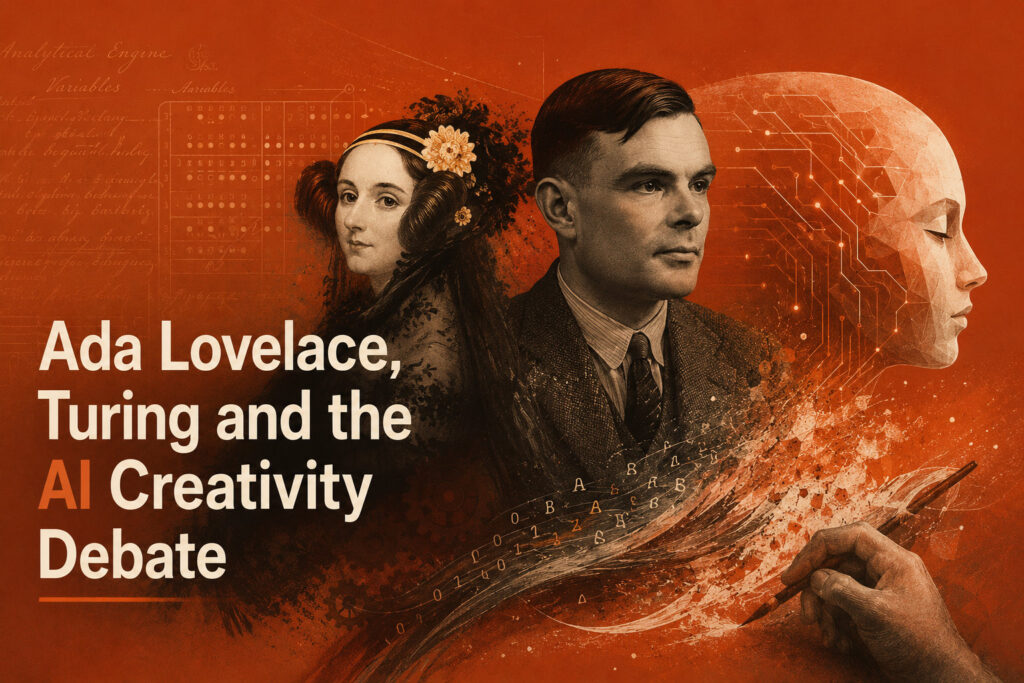
Lovelace’s contribution extended well beyond translation. Her notes were considerably longer than the original article and included what is often regarded as the first published computer program: a sequence of instructions for calculating Bernoulli numbers.
Yet her most important insight may have been conceptual rather than technical. She understood that a general-purpose machine need not be restricted to arithmetic. If something could be represented symbolically, the Engine might manipulate it. Music, for example, could be expressed through formal relationships and processed by the machine, provided those relationships could be represented in a suitable notation.
This was a remarkable idea in the nineteenth century. Lovelace recognised that computation was not essentially about numbers. Numbers could serve as symbols for many different kinds of structure. The machine might therefore operate on music, language, or other formal systems, not because it understood their meaning, but because it could manipulate their encoded relationships.
In that respect, Lovelace saw something fundamental about computing: a machine could be general-purpose even when the material it processed was not numerical.
The qualification
Lovelace’s optimism about the Analytical Engine was accompanied by an equally important reservation. In Note G, she wrote:
The Analytical Engine has no pretensions whatever to originate anything. It can do whatever we know how to order it to perform.
This became known, much later, as “Lovelace’s Objection.”
It is tempting to read the remark as a simple claim that machines can never be creative. But that would make Lovelace’s position more absolute than the historical text necessarily supports. Her point was closely connected to the design of Babbage’s Engine: it could follow formal instructions, but it could not independently formulate the analytical relations or procedures that human beings had not supplied.
Lovelace did not deny that a machine could generate unexpected results. A sufficiently complex calculation might produce an answer that surprises its operator. Rather, she questioned whether the machine itself could be said to originate the method, concept, or intention behind that result.
That is remarkably close to the question still raised about generative AI. When a language model produces an unfamiliar poem, an unexpected analogy, or an apparently original argument, where should we locate the source of that novelty? In the training data? In the model’s architecture? In the prompt? In the interaction between user and system? Or in some combination of all four?
Turing picks up the thread
More than a century later, Alan Turing returned to Lovelace’s argument in his 1950 paper “Computing Machinery and Intelligence.” He described it as one of the principal objections to the possibility of thinking machines.
Turing reformulated the issue. Instead of asking whether a machine could “originate” anything, he proposed a sharper question: could a machine ever “take us by surprise”?
His answer was effectively yes. Turing observed that computers could produce results that their programmers had not specifically anticipated, particularly when a system was given general rules and a large range of possible operations. A programmer might understand the system’s design without being able to predict every consequence of its execution.
Turing also challenged the assumption that human originality was fundamentally different. Human beings, he suggested, might likewise produce novel ideas through processes that depend on previous experience, learned rules, and combinations of existing elements. If recombination disqualified machines from creativity, it might also create difficulties for any account of human creativity.
Turing did not settle the dispute. He shifted it. The argument was no longer simply about whether a machine follows instructions. It became a question about what counts as originality, whether surprise is sufficient evidence of intelligence, and whether human creativity itself can be explained without appealing to some mysterious, non-mechanical faculty.
That shift is now playing out. The panic that generative AI is “killing creativity” rests on a misunderstanding of what creativity is, and of what machines actually do when they generate text, images, or music. The more accurate story is that AI is forcing a redefinition of creative work, not its disappearance.
The myth of the sovereign creator
Much of the anxiety about AI and creativity depends on a Romantic image of the artist: a solitary genius who produces work from pure inspiration, untouched by tools, traditions, or collaborators. Generative AI exposes the fragility of that myth.
Recent scholarship argues that creativity has always depended on distributed infrastructures: archives, techniques, institutions, and labour that the figure of the solitary author conceals. Generative AI does not create a crisis of authorship so much as it reveals that authorship was never as individual as the Romantic story suggested.
From this perspective, AI is not replacing the creator. It is changing the conditions under which creation happens. The human role shifts from “sole originator” to something more like a director, curator, or steward of hybrid systems.
What research demonstrates
Empirical studies of generative AI and creativity point in a consistent direction:
- At the individual level, AI assistance tends to increase creative performance. People using AI tools produce work that is rated as more creative, better written, or more enjoyable, particularly when they start with lower baseline skills.
- At the collective level, AI use can reduce diversity. When many people rely on the same models, outputs become more similar. This “creative homogenisation” raises the floor of quality while lowering the range of distinct ideas.
- AI functions more as a catalyst than a substitute. It accelerates workflows, generates options, and handles routine tasks, but it does not replace judgement, taste, or emotional intelligence.
The pattern is clear: AI changes how creativity happens, not whether it happens.
From execution to direction
The most useful way to understand generative AI is as a shift upstream in the creative process.
Technical execution, drafting sentences, rendering images, arranging chords, becomes easier and faster. The value moves instead to:
- Problem-framing: deciding what to make and why
- Tool selection: choosing models, prompts, and workflows
- Critical evaluation: judging which outputs are worth keeping
- Responsibility: answering for the final work and its effects
Researchers describe this new role as the “prompter-curator”: a human who guides, filters, and takes responsibility for outputs that are always already hybrid.
That is not the death of creativity. It is a reorganisation of it.
The real bottleneck is not technique
Some commentators argue that genuine creativity remains a bottleneck that protects human artists. AI may fill markets with competent content, but it does not yet replicate the conceptual depth, lived experience, or transformative insight that distinguishes breakthrough work.
Others go further, suggesting that AI’s strength in combinatorial and exploratory tasks frees humans to focus on transformative creativity: the kind that redefines categories rather than working within them.
Both views point to the same conclusion: AI excels at generating variations. Humans remain essential for deciding which variations matter and why.
Why the “creativity is dead” narrative persists
The claim that AI is killing creativity serves several purposes:
- It protects existing hierarchies. If creativity is mysterious and exclusive, then professional status remains secure.
- It simplifies a complex transition. It is easier to say “AI destroys art” than to explain how authorship, skill, and value are being redistributed.
- It overlooks history. Every new tool, from the printing press to photography to digital audio, has been accused of undermining creativity. Most have instead expanded it.
The more accurate description is that AI is democratising access to creative production while concentrating power in the platforms that control the models. The threat is not the end of creativity but the narrowing of its ecology.
What this means for creatives
If you work with words, images, or sound, the practical lesson is straightforward:
- Use AI for volume and speed: drafting, research, formatting, iteration
- Protect the parts of your process that generate unusual combinations: ideation, voice, conceptual framing
- Treat AI as a starting draft, not a finished product
- Invest in the human skills that finish the work: judgement, emotional intelligence, ethical responsibility
The creators most likely to thrive are those who treat AI as an assistant for execution while keeping direction and meaning firmly in their own hands.
The constructive conclusion
Generative AI is not killing creativity. It is exposing the assumptions that creativity was ever as individual, mysterious, or non-mechanical as the Romantic story suggested.
Turing shifted the question from “Can machines follow instructions?” to “What counts as originality?” Generative AI is now forcing us to answer it in practice.
The most productive stance is neither panic nor uncritical celebration. It is to recognise that AI is moving creativity upstream: from execution to direction, from technique to judgement, from solitary genius to relational stewardship.
That is not the end of the creative mind. It is a further development in its operations.
Lovelace asked whether a machine could originate anything. Turing replied that the question might be misplaced: if surprise and recombination are enough to count as creativity in humans, why not in machines?
Generative AI does not answer that question definitively. It reframes it. The issue is no longer whether a machine can produce something new. It is whether novelty without intention, understanding, or accountability is enough to count as creative authorship.
Recent work argues that “AI authorship” is a category mistake: statistical systems cannot occupy positions of accountability, vulnerability, or justificatory dialogue. They operate as catalysts within socio-technical assemblages. Identifiable human agents must remain answerable for AI-mediated outputs.
That is the contemporary form of Lovelace’s insight: a machine may generate without originating. The human role is to supply the purpose that makes the output matter.
Sources
Craig, C.J. and Kerr, I.R. (2021) ‘The Death of the AI Author’, Ottawa Law Review, 52(1). Supports the “myth of the sovereign creator” section and the closing argument that AI authorship is a category mistake rooted in accountability, not capability.
Doshi, A.R. and Hauser, O.P. (2024) ‘Generative AI enhances individual creativity but reduces the collective diversity of novel content’, Science Advances, 10(28), eadn5290. Available at: https://doi.org/10.1126/sciadv.adn5290. Supports the “What the research actually shows” section, specifically the individual-gain/collective-homogenisation finding.
Lovelace, A.A. (1843) ‘Notes by the Translator’, in Menabrea, L.F., ‘Sketch of the Analytical Engine Invented by Charles Babbage’, trans. Ada Lovelace, Scientific Memoirs, Vol. 3, pp. 666-731. Source of Note G and the “no pretensions whatever to originate anything” quotation used directly in the piece.
Turing, A.M. (1950) ‘Computing Machinery and Intelligence’, Mind, 59(236), pp. 433-460. Source of “Lovelace’s Objection” as a named argument and Turing’s “take us by surprise” rebuttal.
Editorial Note: The “prompter-curator” term in the “From execution to direction” section is not a verbatim quotation from a single named paper. It reflects a real research direction (see, for instance, arXiv:2505.18938, ‘Beyond Replacement or Augmentation: How Creative Workers Reconfigure Division of Labor with Generative AI’, which documents creative workers reconfiguring roles around generative AI tools), but “prompter-curator” itself should be treated as my editorial framing rather than a cited academic term.