A History of the Internet — and Who Shaped Who
“Well… How Did We Get Here?”Technology, humanity, and who made who
Have you ever looked up from your phone and wondered how exactly the world came to look like this? This is the book that asks that question for you and helps you to understand our place in a digital world. From a Cold War survivability network, through a gift freely given to humanity, to the algorithm now reading this sentence over your shoulder.
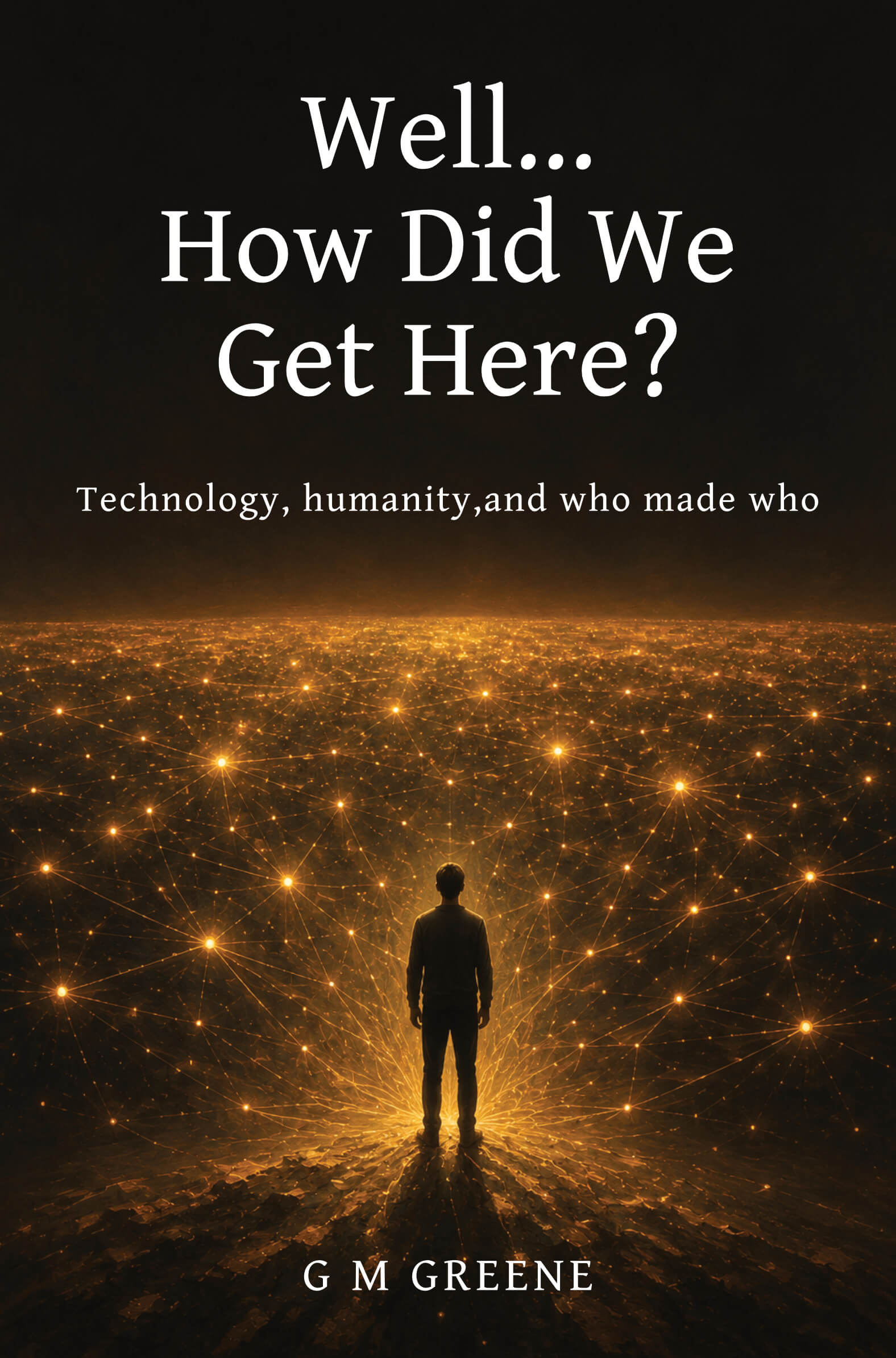
“Well, how did I get here?”
David Byrne asked it in 1981, about a life lived on autopilot. This book asks it about the digital world — the attention economy, the algorithm, the platform that decided what you saw today — and traces, chapter by chapter, exactly how we arrived at this particular moment in time.
A history of the internet, told as a question about ourselves
Well… How Did We Get Here? is a work of accessible non-fiction about technological determinism — the long-running debate over whether technology shapes society, or society shapes technology. Drawing on thinkers from Marx and McLuhan to Shoshana Zuboff and Jonathan Haidt, and tracing the actual history of the internet from a Cold War military experiment to the smartphone in your pocket, the book makes the case that both are true — and that the conversation between them is where everything interesting lives.
Nobody voted for the attention economy. Nobody planned that a Finnish student’s hobby project would become the operating system of the internet. Nobody intended that the World Wide Web — given freely to humanity by one man who believed information should flow without permission — would become the architecture of surveillance capitalism. And yet here we are.
Accessible, personal and evidenced, this book traces the open-source idealists who built the internet’s foundations, the attention merchants who built an economy on top of them, and the neuroscience of what the smartphone in your hand is doing to your brain right now. It is for anyone who has ever wondered how, exactly, the world came to look like this — and whether there is still time to shape what comes next.
“The idealists built the roads.From Chapter Three — The Accidental Revolution
The commercialists built the toll booths.”
Available Worldwide
Choose your format and your local Amazon store.
Paperback
Printed worldwide via Amazon · Expanded DistributionJust published — some marketplace listings may take a day or two to fully activate.
Kindle Edition
Instant download · Read on any deviceFree with Kindle Unlimited where available.
Eleven Chapters, One Question
From a Cold War military experiment to the algorithm reading this page.
The Idea of the Machine
Marx, Ellul, McLuhan, and the two-century-old debate over whether technology drives history.
Before the Web
How a nuclear-survivability network became the open architecture of the internet.
The Accidental Revolution
Stallman’s fury, Torvalds’s hobby, and the hacker ethic that built the open web.
We Shape Our Tools
Churchill, Lanier, and the strongest case for human agency in a digital age.
Then Our Tools Shape Us
What McLuhan, Carr, and Wolf reveal about technology’s grip on the mind.
Written in Neurons
The neuroscience of what your phone is doing to your brain — literally.
The Medium is the Message
McLuhan in full, and what his sixty-year-old warning means for your feed today.
The Attention Merchants
From the 1833 penny press to Zuboff’s surveillance capitalism.
Platform and Power
Who really owns the information environment — and what that means for democracy.
The Speed Problem
Is artificial intelligence moving faster than human wisdom can follow?
Well, How Did We Get Here?
The reckoning — and an honest answer to the question the book began with.
And I Was There
A twist in the final pages that the rest of this page won’t spoil.

G M Greene
Gary M Greene is a British technology writer, graphic designer, and web developer living in rural Portugal where he is also restoring a stone country house — a project he documents on social media as A Nossa Casa Grande.
Gary studied Internet Technology in England, where a module on technological determinism planted a question he has been asking ever since: does technology shape society, or does society shape technology? Well… How Did We Get Here? is his attempt, decades later, to answer that question — written in collaboration with the contemporary technologies available, in a process the book itself describes and defends.
He is also the author of The Compassionate Table, a book exploring plant-based living through the lens of Buddhist ethics and neuroscience.
His professional work spans graphic design, web development, and digital publishing.
Further Reading
Essays extending the book’s argument into new territory. Here's where to start.
Ada Lovelace kick-started the AI creativity debate in 1843. Turing reframed it in 1950. Generative AI is now answering it in practice.
Read the Article →Bloom's Taxonomy places creativity at the top of human cognition. AI lets us start there. That is not progress. It is a short circuit.
Read the Article →The EU AI Act's AI transparency rules came into force on 2 August 2026. The arguments against them are word for word what we heard in the 1990s.
Read the Article →AI consciousness is often conducted at a low level with enthusiasts claiming that ChatGPT is clearly sentient. Discuss.
Read the Article →AI courtesy is real; nearly half of us say please to chatbots. The research on whether it helps is surprising. Here is what it reveals.
Read the Article →Hiring and credit scoring systems make life-changing decisions and offer no explanation. Algorithmic discrimination and why the computer says no.
Read the Article →We misunderstood the term hacker and labelled them as criminals. Aren't we doing the same with AI? Here is why the language we use is really important.
Read the Article →Eric Raymond's Cathedral and the Bazaar predicted GitHub, Wikipedia, and the open source revolution. What it got right — and what it missed.
Read the Article →Lawrence Lessig warned in 2001 that the internet commons was under threat. The Future of Ideas told us exactly how we got here.
Read the Article →