The Reading List That Made Me: Rebel Code
Part 1 of 4 in a series on the books that shaped “Well… How Did We Get Here?”
I was introduced to Rebel Code on my Internet Computing course at Hull University in 2007, on a reading list for a module with a title: Decoding the Digital Society. We were given a shortlist of essay questions to pick from, and I chose this one:
“Technological determinism is just a fancy term for something that is around us every day. Discuss with reference to the theories of Marshall McLuhan in a contemporary situation.”
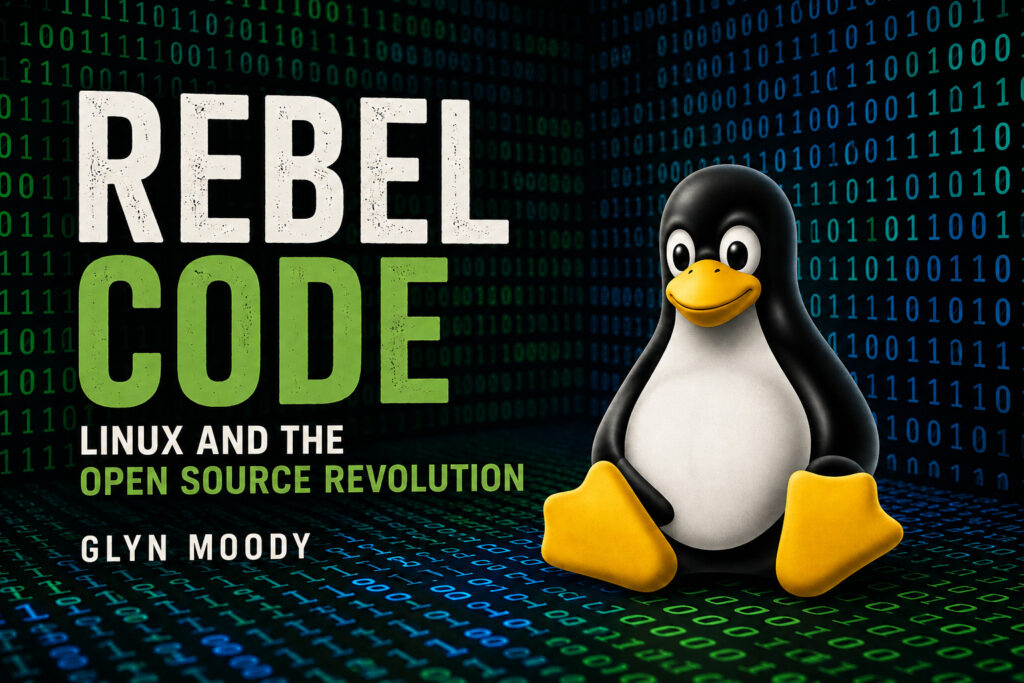
On paper and to my untrained academic research eyes, this question had absolutely nothing to do with Glyn Moody’s history of Linux. So I did the entirely reasonable first year student thing and skipped it.
It sat there, unread until the following summer, when I picked it up while on holiday in the south of France. I simply couldn’t put it down. It reignited something. Not just an interest in open source specifically, but the whole subject that question had first pointed me toward: why technology ends up looking the way it does, and who’s actually deciding that. Rebel Code has been my go-to book ever since and whenever I need to reignite that spark.
Why this book still matters
Glyn Moody’s Rebel Code isn’t really a book about Linux. Or rather, it is — it’s a meticulous, blow-by-blow account of how Linus Torvalds’s hobby operating system grew into a force that rattled Microsoft — but underneath the technical history is a much bigger question: what happens when a community decides to build something valuable and simply give it away?
Moody traces the free software movement back to Richard Stallman’s founding of the GNU Project in the early 1980s, through Torvalds’s first, almost accidental release of the Linux kernel, to the moment by 2000 when GNU/Linux was running everything from handheld devices to the world’s biggest supercomputers. What makes the book compelling isn’t the timeline — it’s the people, their thinking and reasoning behind the decisions they made. Moody interviewed dozens of the programmers, idealists, and eventual business leaders who built this thing, and what comes through is a genuine culture clash: a loose, argumentative, deeply collaborative community running headlong into the commercial software industry’s entire logic of ownership and control.
The idea that stuck with me
Open source works because it inverts the incentive structure most of us assume software has to run on. Instead of hoarding the code to protect its value, the community’s instinct was the opposite: the more eyes on the code, the better and more resilient it becomes. It’s a genuinely radical idea, and it’s easy to forget now — twenty-odd years after Linux became infrastructure everyone quietly depends on — how strange and even threatening that idea seemed to the established players at the time.
Why it’s part of this book
Well… How Did We Get Here? is a book about how technology got its hooks into every corner of daily life, and Rebel Code is where I first understood that the shape of our digital world was never inevitable. Open source was one fork in the road — a community-driven, non-proprietary way of building the infrastructure we now all rely on. The internet we actually got looks very different from that vision in a lot of ways. Reading Moody’s account of that early idealism is part of what got me asking the bigger question the book tries to answer: not just what happened, but who decided it should happen this way — and could it have gone differently?
If that question interests you, it’s the one I spend the whole book chasing.