Standing Reserve: What Heidegger Saw Coming Before the Algorithm Existed
Heidegger, a German philosopher writing about hydroelectric dams in 1954, described exactly what your phone is doing to you right now.
There is a particular feeling that arrives sometime after the fortieth minute of scrolling. It is not quite boredom and not quite pleasure. It is the sense of having been used by something, gently and without violence, for a purpose you never agreed to and can no longer quite locate. You put the phone down feeling slightly less like a person who made choices today and slightly more like a resource that was drawn upon.
In 1954, a German philosopher who had never seen a smartphone gave that feeling a name. He called it standing-reserve. And the essay in which he named it — addressed to dams, sawmills, and the German countryside — turns out to be one of the most precise descriptions of the attention economy ever written, arriving roughly seventy years before the thing it describes.
The Man Who Asked the Wrong Question on Purpose
Martin Heidegger’s The Question Concerning Technology opens with a deceptively simple move. Most people, he observes, think they already know what technology is: a tool, a means to an end, a neutral instrument that humans pick up and put down at will. A hammer. A telephone. A search engine. Useful, dangerous, helpful, harmful — but always, in this common-sense view, just a thing we use, entirely separate from us, entirely under our control.
Heidegger thought this common-sense view was true as far as it went, and almost useless as an account of what actually matters. The “instrumental” definition of technology, he argued, tells you what technology does. It tells you nothing about what technology is — about the deeper way of encountering the world that modern technology both expresses and enforces. To find that, he proposed, you have to stop asking what technology accomplishes and start asking what it reveals.
His answer was a single, difficult, untranslatable German word: Gestell. English translators have rendered it as “enframing,” and the word is worth sitting with, because it is doing exactly what it sounds like it’s doing — putting a frame around something, and in doing so, deciding in advance what can appear inside it and what cannot.
The River and the Standing-Reserve
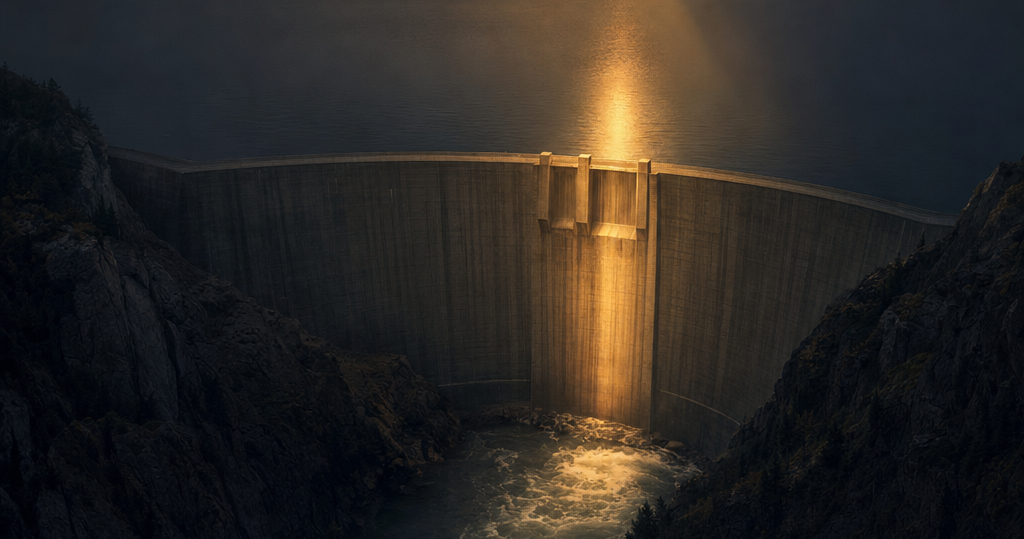
Heidegger’s central example is a hydroelectric dam on the Rhine. Before the dam, the river simply runs — a river doing what rivers do, indifferent to human purposes, meaningful in itself, on its own terms. After the dam, Heidegger argues, something has happened that goes deeper than mere construction. The river has been enframed. It has been revealed, henceforth, primarily as a power source — as what he calls standing-reserve: a stock of potential energy, banked and waiting, ready to be called upon, valuable precisely insofar as it is available for use.
The river has not disappeared. Tourists can still photograph it; poets can still write about it. But its primary mode of being, within the technological framework that now contains it, is as a resource on call. It has been isolated and transformed into a stockpile, valuable for its later utility rather than for what it simply is. This is enframing’s basic move: it does not destroy the thing it touches. It re-describes the thing’s very being as availability.
Heidegger’s danger — and he was explicit that this was the danger he meant to name — is that enframing does not stop at rivers. Pushed to its logical extreme, it turns human beings themselves into a kind of resource, which is why, he suggests, we have come to speak so naturally of “human resources” rather than people, workers, or souls. Once the frame is in place, everything that falls within it — rivers, forests, and eventually human attention, human time, human behaviour — becomes available first, and is second.
Heidegger’s Astonishing Detour Into Radio
What makes “The Question Concerning Technology” remarkable for a book about the digital age is a passage that has nothing to do with dams at all. Heidegger, working through the implications of enframing for human communication, turns briefly to the press and to radio — the algorithmic feed of his own historical moment — and the passage reads now less like 1954 and more like a leaked internal memo from a platform trust-and-safety team.
The press and radio, Heidegger writes, “set public opinion to swallowing what is printed, so that a set configuration of opinion becomes available on demand.” Public opinion itself, in other words, becomes standing-reserve — a stockpile of pre-shaped sentiment, ready to be drawn upon, produced and reproduced by a system whose business is the manufacture of availability.
And then comes the sentence that should stop any reader of this book cold. The radio listener, Heidegger notes, seems free — he is, after all, entirely free to turn the device on and off. But this freedom is illusory: the listener remains confined within the technological system that produces public opinion regardless of whether the device is switched on, free only in the thin sense that he must continually free himself from the coercive insistence of a public sphere that persists whether he is listening or not.
Replace “radio” with “smartphone” and “public opinion” with “the feed,” and you have, almost without alteration, the central argument of the attention-economy chapters of this book. You are free to put the phone down. You are not free from the system that has already shaped what waits for you the next time you pick it up, or from the fact that everyone around you is being shaped by the same system whether or not you personally are watching in any given moment. Heidegger named this seventy years before Zuboff named surveillance capitalism, using nothing more advanced than a wireless radio set.
“Human Resources” Was Always the Tell
There is a detail in Heidegger’s argument that deserves to be lingered over because it is so easy to walk past. He points out, almost in passing, that modern bureaucratic language no longer speaks of workers or labourers but of human resources — and that this shift in vocabulary is not a cosmetic update but a confession. The phrase tells you, plainly, how the enframed world has come to regard the people inside it: not as ends in themselves, but as a category of standing-reserve, alongside coal, timber, and hydroelectric capacity, distinguished from those other resources only by being more complicated to manage.
The contemporary equivalent is not hard to find. The platforms that built the attention economy this book describes in its middle chapters do not, internally, talk about people. They talk about users, engagement, time-on-platform, daily active users — a vocabulary of standing-reserve every bit as revealing as “human resources,” describing human attention as a stock of value to be drawn down, monetised, and replenished. Heidegger would not have been surprised by any of it. He would have said: of course this is what happened. This is what enframing always does, once it has somewhere new to extend itself.
Was Heidegger a Hard Determinist?
It would be easy to read all of this and conclude that Heidegger belongs firmly in the hard determinist camp this book examines in its opening chapter — that for him, technology simply happens to us, an inexorable historical force against which human agency is powerless. He resists that reading himself, carefully and at some length.
Heidegger insists that his account of enframing expresses something quite different from the common claim that technology is simply “the fate of our age,” where fate means the inevitableness of an unalterable course. Enframing is a destining, in his careful vocabulary — a way that the world is currently disclosing itself to us — but a destining is not the same as a fate sealed shut. Heidegger develops, alongside enframing’s danger, a counter-concept he calls “granting” — the idea that what truly endures is what is given rather than merely extracted, and that the relationship between human beings and technology remains, even within enframing, something that can still be otherwise.
This is, in its own philosophical idiom, exactly the position this book has argued from its first chapter onward: that the shaping is real and often invisible to those living inside it, but that it is not, for that reason, beyond the reach of human attention and human choice. Heidegger’s famous, much-debated answer to his own question was that the first step toward a freer relationship with technology is simply noticing the frame — seeing enframing as enframing, rather than mistaking it for simply how the world is. You cannot resist a frame you have not noticed you are standing inside.
What This Means for the Phone in Your Hand
Heidegger never used a smartphone, never saw a newsfeed, never encountered a recommendation algorithm trained on a billion data points to maximise the time you spend looking at it. He did not need to. What he offers this book’s argument is not a prediction but something more useful: a description of the structure by which any sufficiently advanced technological system comes to redefine the people who use it as a resource to be drawn upon, available on demand, valuable chiefly for what can be extracted from their attention — and a quiet, careful argument that the first and most necessary act of freedom is simply to notice this is happening.
The river beneath the dam is still a river. It has just been told, by the frame placed around it, what it is now primarily for. The question Heidegger leaves every reader of this book to answer for themselves is whether they are willing to ask the same question about their own attention — and whether noticing the frame is enough to begin, in some small way, to step outside it.