The Reading List That Made Me: Smart Mobs
Part 2 of 4 in a series on the books that shaped
“Well… How Did We Get Here?”
There is an image conjured in Howard Rheingold’s Smart Mobs: The Next Social Revolution that frequently come to mind. It is 2001. The Philippines. President Joseph Estrada is facing impeachment proceedings, the trial is faltering, and the evidence against him has been suppressed by his supporters in the Senate. Within hours, a million Filipino citizens are on the streets of Manila. Not summoned by a newspaper, not organised by a political party, not called to action by a television broadcast. Mobilised by text messages. Forwarded from phone to phone to phone until the crowd assembled itself, without a centre, without a leader, without any single point of control.
Estrada fell. And Rheingold, watching from the other side of the world, understood that something genuinely new had just happened — something that would change how human beings organised collective action for decades to come.
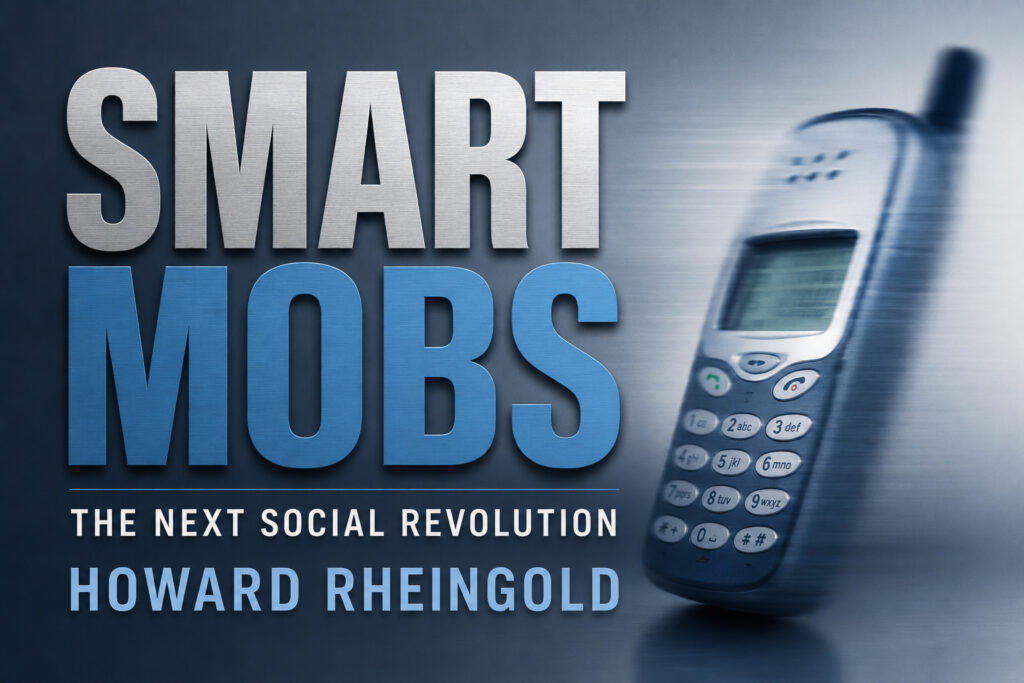
Smart Mobs, published in 2002, is the book he wrote to explain what that something was. And it is the book that made me understand — for the first time, really — that the relationship between technology and society doesn’t just run one way.
What Rheingold Actually Argued
Most people who remember Smart Mobs remember the flash mob — the slightly absurd early 2000s phenomenon of strangers converging on a public place to perform a coordinated, pointless act, then dispersing. That cultural moment has aged somewhere between charming and embarrassing. But it was never really what the book was about.
Rheingold’s actual argument was considerably more serious and considerably more prescient. Smart mobs, he argued, use mobile media and computer networks to organise collective actions — from swarms of tech-savvy youth in urban Asia and Scandinavia to citizen revolts on the streets of Seattle, Manila, and Caracas. What made them genuinely new wasn’t the technology itself — mobile phones and SMS had been around for years — but the emergent behaviour that technology made possible when enough people had it in their pockets simultaneously.
Rheingold defined the smart mob precisely: “Smart mobs consist of people who are able to act in concert even if they don’t know each other… because they carry devices that possess both communication and computing capabilities.” The key phrase is “even if they don’t know each other.” Previous forms of collective action required either a pre-existing organisation, a shared physical space, or a trusted intermediary — a union, a church, a newspaper editor — to coordinate people toward a common purpose. The mobile phone dissolved all three requirements simultaneously. You could coordinate with strangers, across distance, in real time, without anyone in charge.
The Tokyo teenagers Rheingold observed in Shibuya — hanging out together all day despite being in different places, sending hundreds of text messages on their iMode phones — looked trivial from the outside. What he saw was a new form of social architecture being built from the bottom up, without anyone planning it.
The Sentence That Changed How I Read Everything Else
There is a line near the end of Smart Mobs that I have come to consider as really important. Rheingold, having spent two hundred pages documenting the extraordinary things mobile technology was enabling, stops and says something that cuts against the entire celebratory momentum of the book: the real impact of mobile communications will come not from the technology itself but from how people use it.
That sentence is the hinge on which everything turns. It is a soft determinist argument made in plain English, published in 2002, before the smartphone, before the social media feed, before the algorithmic amplification of outrage. The technology doesn’t determine the outcome. The people do. But the technology sets the terms within which the people act — and those terms matter enormously.
Rheingold was honest enough to see both sides of what he was describing. He considered the dark side of the phenomenon too: the coordination of terrorist cells, threats to privacy, the ability to incite violent behaviour. The same architecture that toppled Estrada could coordinate a mob. The same text-message chain that assembled a million peaceful demonstrators could assemble something uglier. The technology was indifferent to the purpose. The people were not — but the technology shaped which purposes became easy and which remained difficult.
Why This Felt Personal
I read Smart Mobs in the middle period of my degree at Hull, when I was still trying to work out what the question of technological determinism actually meant in practice rather than in theory. Rebel Code had shown me that the shape of our digital world was a product of specific human choices. Smart Mobs showed me something complementary: that even after those choices were made and the technology was in people’s hands, the story wasn’t over. People were still making choices. The technology was enabling some of those choices and constraining others. The relationship was dynamic, not settled.
What struck me most — and what still strikes me now — is that Rheingold was writing about all of this in 2002, when the mobile phone was still primarily a device for phone calls and the occasional text message. He was watching teenagers in Tokyo and protesters in Manila and extrapolating, with remarkable accuracy, toward a world in which the device in your pocket would become the primary medium through which you experienced social life, political reality, and the news.
He didn’t predict TikTok. But he described the architecture from which TikTok was built. And he warned — quietly, in that one sentence — that the architecture alone wouldn’t determine what was built on top of it. That was always going to be a human decision. We just haven’t always made it consciously.
What This Book Gave My Own
Well… How Did We Get Here? is, among other things, a book about the gap between what mobile and social technology made possible and what it actually became. Rheingold’s vision — of technology as a cooperation amplifier, of the mobile phone as a tool for bottom-up democratic organisation — is part of the story. So is the attention economy’s rather different vision of what those same devices were for.
Reading Smart Mobs again while writing my book, what strikes me is not how wrong Rheingold was but how right he was about the wrong thing. The technology did change collective action. It did dissolve the old requirements for organisation. It did enable people to act in concert without knowing each other. Every one of those predictions came true. What he couldn’t have anticipated — what nobody fully anticipated — was that the same architecture would be so thoroughly colonised by commercial interests that the cooperation it amplified would increasingly be cooperation directed toward engagement metrics rather than collective purpose.
The smart mob became the viral moment. The text-message chain became the algorithmic feed. The cooperation amplifier became, in Zuboff’s terms, a behaviour modification machine. Not because the technology determined that outcome. Because specific people made specific choices — and the rest of us, mostly, didn’t notice until it was already done.
That is the question Well… How Did We Get Here? spends eleven chapters trying to answer. Smart Mobs is where I first understood it was a question worth asking.